Telegram Payment Gateway: How to Take Payments in Chats
Card providers, Telegram Stars or USDT in chat? How to pick a Telegram payment gateway for your shop, bot or service, and what each route costs.
By Aaron, PAYchat founder · PAYchat team · Updated
You run a shop, a bot or a small service on Telegram, and people keep asking, "How do I pay you?" You don't want to send them off to some random checkout page. You want the money to move right where you're already talking.
That's what most people mean by a Telegram payment gateway. Here's the thing, though: there isn't just one. There are three pretty different routes, and which one you need comes down to what you sell and how your buyers like to pay.
What counts as a payment gateway on Telegram?
A payment gateway is just whatever takes money from your customer and gets it to you. On Telegram, that can look three different ways.
Telegram has its own Payments feature for bots. But Telegram says it doesn't process payments from users itself. Your bot plugs into a third-party provider, and that provider handles the card details.
Then there's Telegram Stars. If you sell digital goods or services inside a bot, Telegram points you there instead of to card providers.
And if your buyers would rather skip cards completely, there's a wallet right inside Telegram where they pay in USDT, a stablecoin that tracks the US dollar. That's the route PAYchat takes.
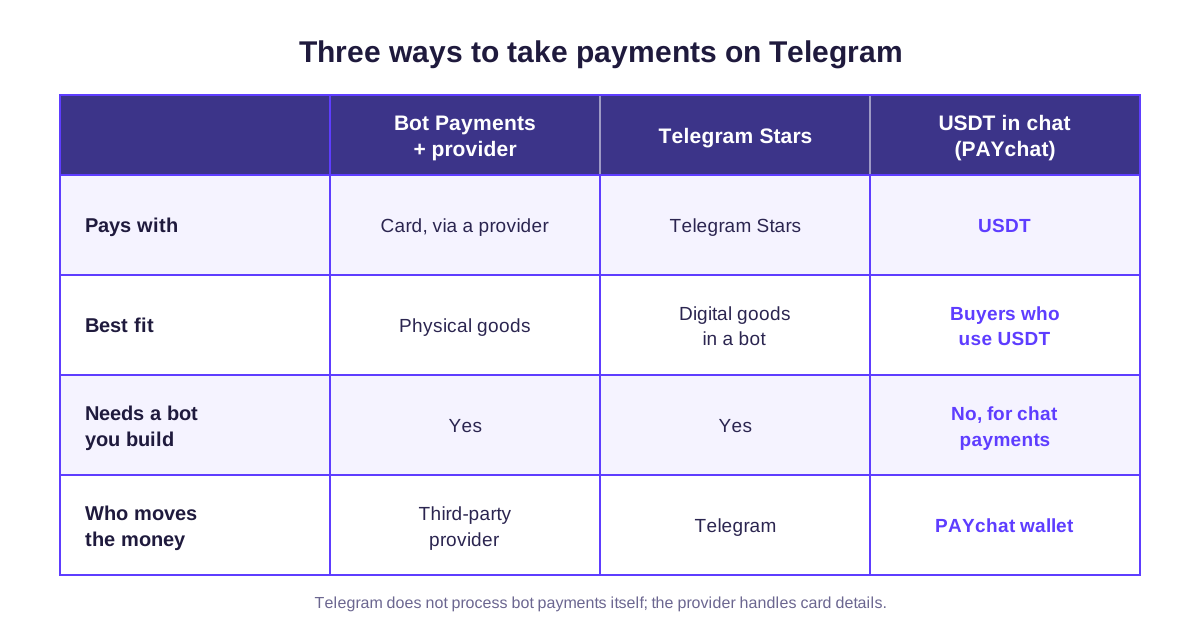
Here's how the three stack up:
| Bot Payments + provider | Telegram Stars | USDT in chat (PAYchat) | |
|---|---|---|---|
| Pays with | Card, via a provider | Telegram Stars | USDT |
| Best fit | Physical goods | Digital goods in a bot | Buyers who use USDT |
| Needs a bot you build | Yes | Yes | No, for chat payments |
| Who moves the money | Third-party provider | Telegram | PAYchat wallet |
Which route fits what you sell?
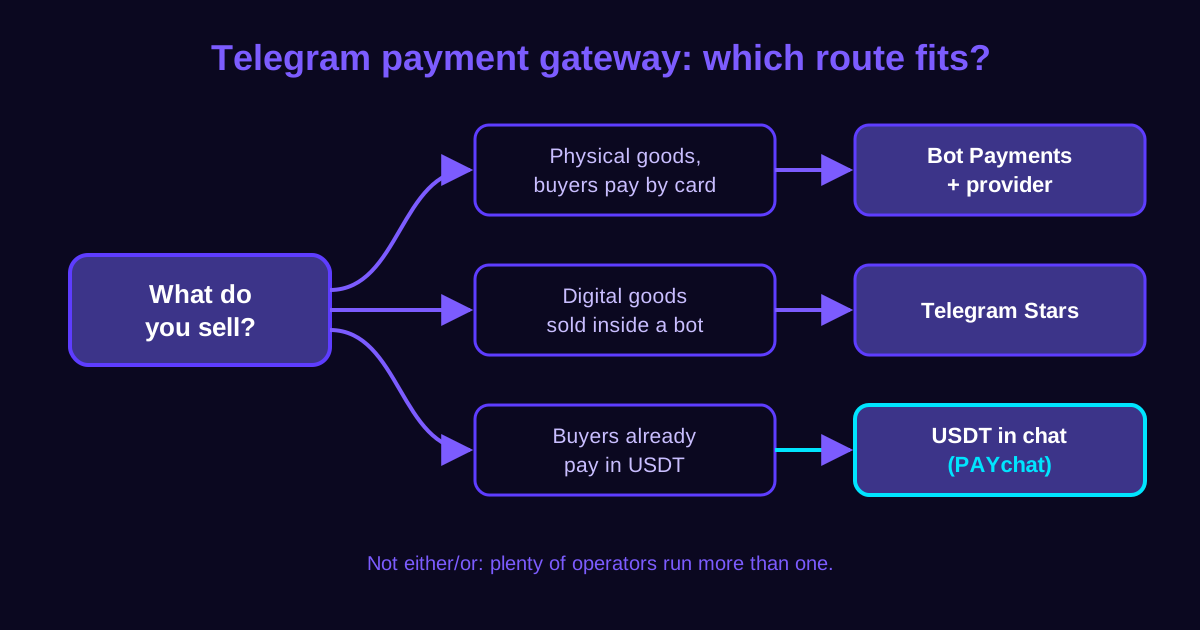
Looking at that table, it really boils down to two questions. Is your thing physical or digital? And do your buyers want to pay by card or in crypto?
Shipping physical products to people who expect to pay by card? The provider route is your natural fit. Selling something digital inside a bot? Telegram expects Stars there.
But maybe your buyers live where cards are hard to get, or USDT is already how they send money. Then a wallet in the chat just makes sense. Nobody types a card number, and nobody leaves Telegram.
Oh, and it's not either/or. Plenty of operators run more than one.
How do you take USDT payments without writing code?
So say USDT sounds like your crowd. Good news: you don't have to build a checkout page at all.
PAYchat is a Telegram Mini App, which is just a small app that opens inside Telegram. You and your customer open it in the chat, and they send you USDT. If you're both on PAYchat, that send is free.
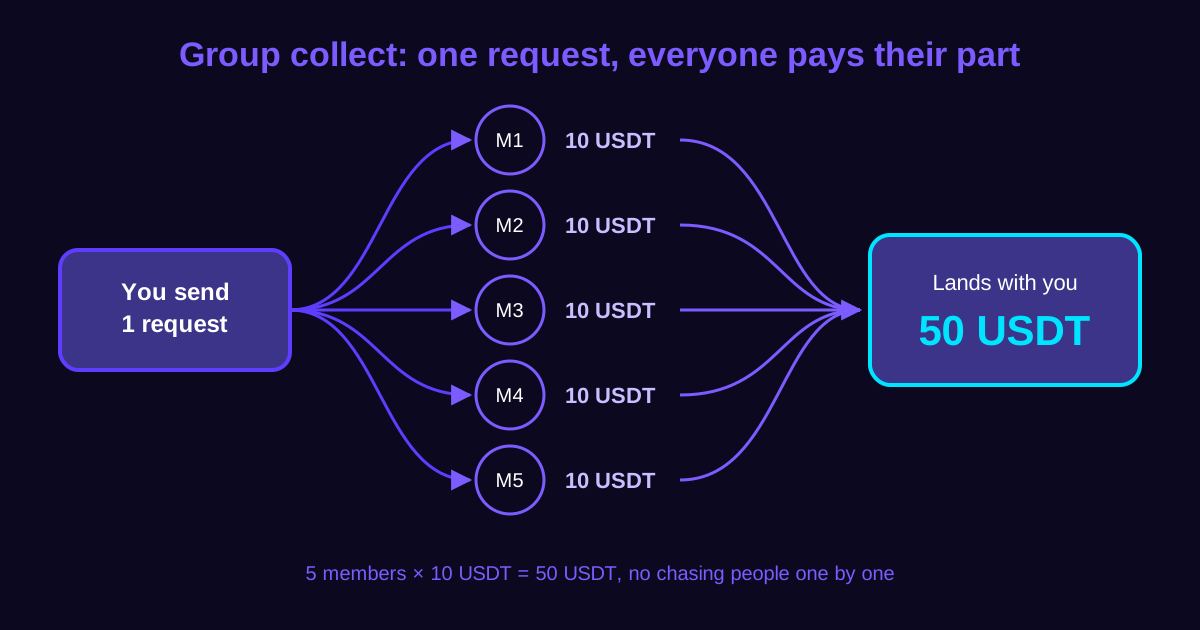
It gets more useful when you're collecting from a bunch of people. Think a group order, a class, or a shared subscription. With group collect, you send one request to the whole group and everyone pays their part. Five members owing 10 USDT each? One request, 50 USDT in, and no chasing people one by one.
Selling to someone who doesn't know you yet is a different story, because they're nervous about paying first. That's where escrow comes in. Escrow is basically a middle step that holds the money: the buyer's USDT is held until you deliver, then it comes to you.
Got your own shop already? The partner catalog API lets you list PAYchat products and take orders there. And if you're a developer who wants webhooks and an SDK inside your own app, that's a whole other topic, covered on this PAYchat page for developers.
What does each kind of payment cost?
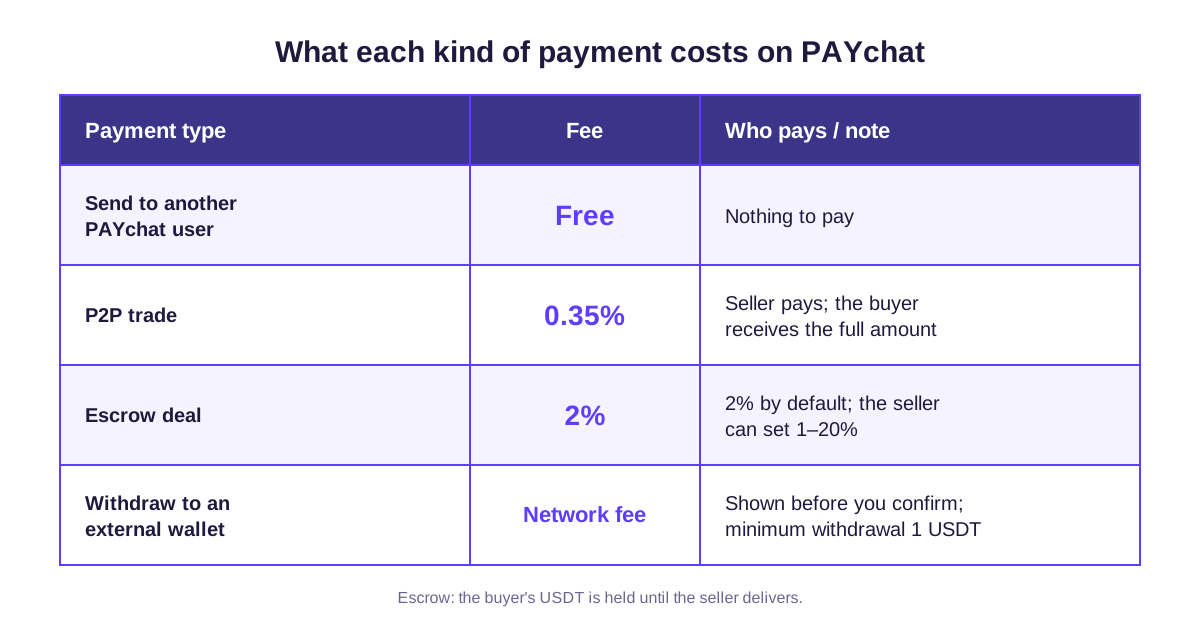
Now, "free" only covers sends between users. Other kinds of payments have their own fees.
If you buy or sell USDT directly with another person, that's a P2P trade, and it costs 0.35%. The seller pays it, so the buyer gets the full amount.
Escrow deals cost 2% by default, and the seller can set the fee anywhere from 1% to 20%. Curious how that compares? Here's a side-by-side of escrow services.
The table below lays out all four, including what it costs to pull money out to an outside wallet.
Where can the money come in and go out?
Speaking of pulling money out, this is the part that catches people off guard.
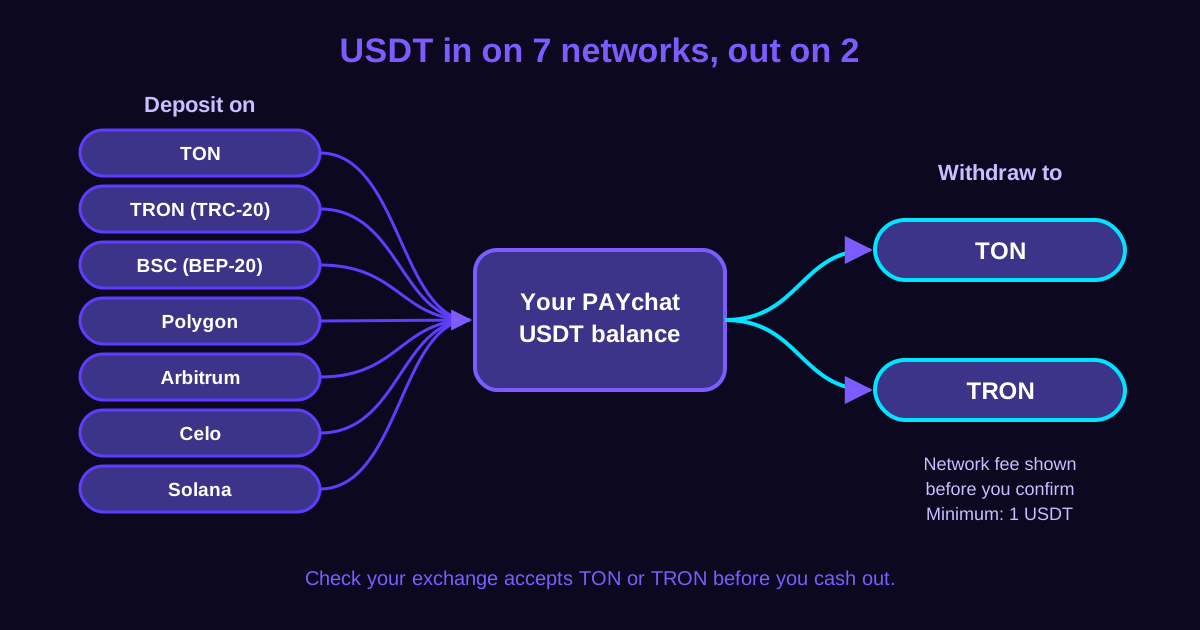
Getting money in is easy. Your customers can deposit USDT on TON, TRON (TRC-20), BSC (BEP-20), Polygon, Arbitrum, Celo or Solana, so they can usually pay from whatever wallet or exchange they already use.
Getting money out is narrower. You withdraw to an external wallet on TON or TRON, and you'll see the network fee before you confirm. The minimum withdrawal is 1 USDT.
So USDT comes in on 7 networks but goes out on 2. Check your exchange accepts TON or TRON before you cash out.
What should you watch out for?
I want to be straight with you about where this route doesn't fit.
It's USDT only. If your customers just want to tap a card and go, a USDT wallet won't work for them, and the provider route is the better call.
Your buyer needs PAYchat too. Chat payments happen between PAYchat users, so someone paying you for the first time has to open the app first.
Remember that free sends don't mean everything's free. P2P trades, escrow deals and withdrawals each cost something, so build that into your prices.
And the withdrawal networks matter. Even if a customer paid you on Solana, you'll cash out on TON or TRON.
None of these are deal-breakers. They just help you decide whether USDT in chat should be your main Telegram payment gateway, or one option next to cards and Stars.
PAYchat numbers in this guide come from PAYchat's own listing data as of Nov 14, 2026. Telegram rules are linked to official Telegram pages.
All guides and comparisons15 guides · 4 comparisons
Telegram channel ads


